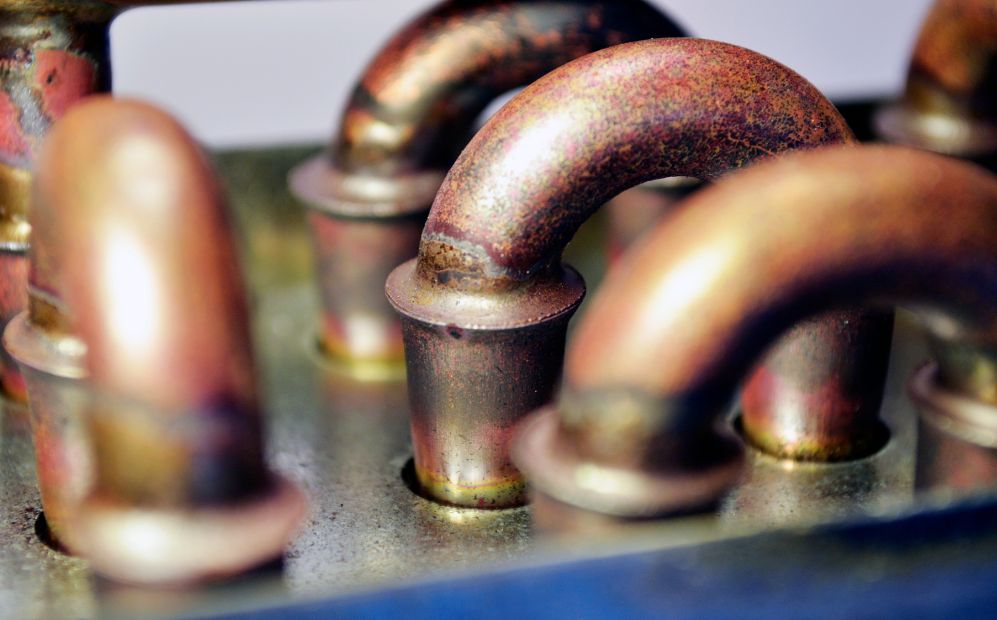
What is copper brazing
Brazing is a joining process that connects two metallic components through the melting of a filler alloy, without melting the base metal. The alloy, distributed by capillarity into the gap between the two mated parts, solidifies creating a mechanically strong and watertight joint.
In the case of copper, this principle is applied daily in the construction of piping and manifolds for refrigeration circuits, air conditioning systems, and commercial refrigeration lines.
As with all high thermal conductivity metals, controlling the heating is the key factor for joint quality in copper as well. The copper brazing process follows the same controlled heating logic applied to the induction brazing of metals, of which this process represents a specific application.
We are talking about a material with high thermal conductivity, as seen when covering the copper tinning process: this metal rapidly dissipates heat applied at a specific point toward the neighboring areas of the component.
If not managed correctly, this characteristic leads to two recurring problems in open-flame brazing: localized overheating, which weakens the metal’s crystal structure in areas adjacent to the joint, and uneven cooling, which generates residual stress along the pipe.
For this reason, every copper brazing process requires precise temperature control of the alloy’s melting point and holding time—parameters that in manual welding largely depend on operator experience.
In industrial practice, the terms welding, soldering, and brazing are often used interchangeably, but they indicate distinct processes defined by the melting temperature of the filler alloy.
We will cover this in detail in an upcoming article: for now, we will introduce a few general definitions.
Difference between welding, soldering, and brazing
Welding joins parts by melting the base metal as well, with or without filler material.
Brazing (or hard soldering) joins components without melting the base metal, using a filler alloy that distributes itself by capillarity within the joint gap. Capillary brazing is an equivalent term, typically used when joint preparations resemble those of fusion welding.
Specifically, brazing is necessary when joining metals or alloys with different melting points, such as copper paired with other materials in HVAC circuits: the filler alloy, having a lower melting temperature than the base metals, enables joining without compromising their properties.
It is this characteristic that makes brazing the standard choice for copper manifolds and piping in HVAC circuits, where the joint must withstand vibrations, thermal cycles, and refrigerant fluid pressure.
Copper brazing in HVAC and refrigeration circuits
In the manufacturing of compressors, heat exchangers, and refrigeration circuits, copper brazing involves dozens of joints per single unit: multiple manifolds, fittings between pipes of different diameters, and 4-way reversing valves. On these components, production cycle repeatability is as critical as the quality of an individual joint, because an HVAC unit can contain numerous brazing points that must all comply with standards.
This is true, for example, in copper manifolds for ventilation and refrigeration circuits or 4-way reversing valves, where multiple connections are brazed sequentially on the same component.
Compared to open-flame brazing, induction heating offers measurable advantages precisely at copper’s critical points.
Why induction replaces flames in copper circuits
- Localized heating: the electromagnetic field generated by the inductor heats exclusively the joint area, without propagating heat along the rest of the piping. This reduces the risk of overheating gaskets, valves, or components located just a few centimeters from the brazing point.
- Constant joint gap: controlling power, time, and temperature via PTT programs allows each joint to be heated according to an identical profile, keeping the gap between the two mated components constant and promoting proper alloy capillarity.
- More precise flux application: the ability to accurately modulate temperature reduces surface oxidation of copper during heating, allowing for more precise flux dosage compared to an open flame.
- Cycle repeatability: each brazing program, once configured, yields an identical result regardless of the operator, fulfilling the requirements for industrial mass production of manifolds and valves.
These factors explain why induction has progressively replaced flames even in medium-series production: for example, in high-joint-density refrigeration circuits like multi-split unit manifolds, which feature dozens of connections on the same frame.
Which filler alloy to use
The choice of filler alloy depends on the type of joint and the stress it will undergo during operation.
- Self-fluxing CuP (copper-phosphorus) alloys: contain varying percentages of phosphorus, which acts as a natural flux on copper during melting. Consequently, they do not require additional flux when joining two copper components, simplifying the process.
- CuAgP (copper-silver-phosphorus) alloys: the addition of silver lowers the melting point and enhances joint resistance to repeated vibrations and thermal cycling. This is the ideal choice when the joint must offer greater ductility and resistance to repeated thermal cycles, or when lowering the process temperature relative to pure CuP alloys is required. It is applied in both HVAC and other sectors where joint stress is higher. It represents the standard solution in industries like automotive, where compressors and valves subjected to frequent starts and stops require this alloy; in HVAC, as noted, the same stress is generally handled with CuP alloys.
- Silver-based alloys with separate flux: used when the joint involves steel or brass components—such as fittings between copper piping and connectors made of different materials—where the phosphorus in CuP alloys would not provide adequate wettability (capillarity).
In all cases, the alloy melting temperature—which can reach up to approximately 800°C for phosphorus alloys used in the HVAC sector—is set as a process parameter in the generator program, along with the holding time required to complete capillarity.
SEIT technologies for HVAC brazing
The Platinum generator series by SEIT Elettronica is used in various industrial processes, including the brazing of copper components in HVAC and refrigeration circuits.
The generator Platinum MF, for instance, available from 5 to 25 kW, cover brazing needs for medium-to-large diameter manifolds and pipes typical of commercial and industrial refrigeration circuits.
The integrated software allows operators to save and recall power, time, and temperature programs for every processed pipe diameter, ensuring the exact same heating cycle is reproduced across different production batches.
For high-throughput production lines—where multiple brazing, washing, and marking stations must be integrated into a single automatic system—the Platinum HUB platform allows combining multiple generators from the series with loading stations, flux dispensing, and inline quality control.
Key advantages of SEIT Elettronica technologies for brazing include:
- Real-time temperature reading: pyrometers or thermal cameras, depending on component geometry, modulate output power during the cycle, avoiding localized overheating on previously brazed points.
- Cycle traceability: every brazing operation is recorded with the actual power, time, and temperature parameters applied—a data requirement increasingly requested for HVAC supplier qualification.
- Automation compatibility: integrated communication boards in Platinum generators allow direct integration into existing automatic lines without redesigning the entire brazing setup.
This combination of precise control and traceability renders the brazing process repeatable, accurate, and ready for mass industrial production.
Want to evaluate the most suitable brazing solution for the diameters, alloys, and production volumes managed by your company? Contact the SEIT Elettronica technical team.